No Odds, No Problem: Five Olympic Underdogs Who Had Absolutely No Business Winning — and Won Anyway

Photo by Photo by Jonathan Borba on Unsplash on Unsplash
The Olympics love a narrative. Networks build them, sponsors fund them, and broadcasters deliver them with the kind of breathless reverence usually reserved for religious events. But the stories that actually last — the ones people are still telling thirty years later at dinner tables and in sports bars — aren't usually about the favorites.
They're about the people who weren't supposed to be there at all.
Here are five athletes whose paths to the podium had no business leading where they did.
1. The Jamaican Bobsled Team (1988 Calgary Winter Olympics)
Let's start with the one everyone knows, because knowing about it and actually sitting with it are two different things.
Jamaica is a Caribbean island nation with a mean temperature somewhere in the mid-80s Fahrenheit. It has no mountains. It has no bobsled tradition. It has no infrastructure for winter sports of any kind. In 1988, a group of Jamaican sprinters — recruited partly because bobsled pushers need explosive speed at the start — decided they were going to compete at the Calgary Winter Games anyway.
They'd been on a bobsled for a total of a few weeks before the competition. They crashed during their run. They got up, picked up the sled, and walked it across the finish line with their heads held high. The Calgary crowd gave them a standing ovation that had nothing to do with their time.
What they did that day wasn't win a medal. It was something more durable: they demonstrated that showing up, fully committed, with zero expectation of an easy ride, is its own form of victory. The team has competed in multiple Winter Olympics since. The story hasn't gotten old because the principle behind it hasn't gotten old either.
You don't have to have been born in the right place. You just have to decide you belong.
2. Matt Stutzman, the Armless Archer (2012 London Paralympics)
Matt Stutzman was born without arms. He grew up in Iowa, adopted into a family that encouraged him to figure out how to do things rather than cataloging what he couldn't. He learned to drive. He learned to use his feet the way most people use their hands. And somewhere along the way, he picked up archery.
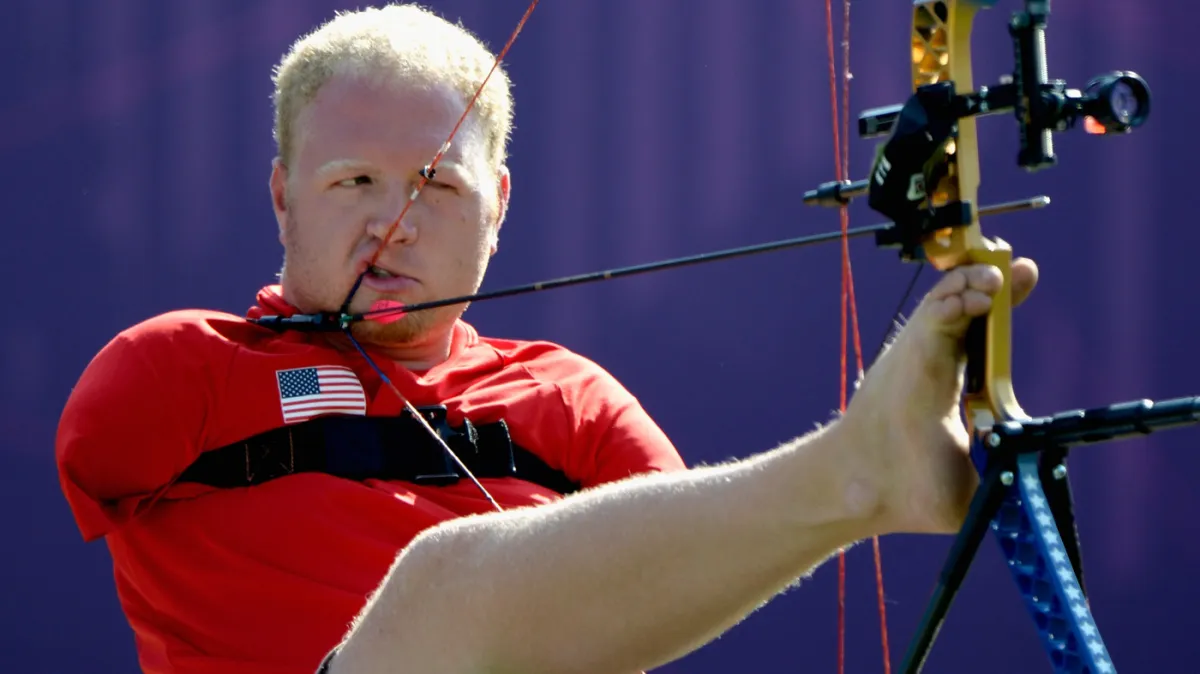 Photo: Matt Stutzman, via media.npr.org
With his feet.
By the time Stutzman arrived at the 2012 London Paralympic Games, he had developed a technique — drawing the bowstring with his foot, stabilizing the bow with his shoulder — that was entirely his own invention. No coach had designed it. No training manual had described it. He built it from scratch because the standard method wasn't available to him.
He won silver at London. He went on to set a Guinness World Record for the longest accurate shot in archery history — 310 yards — and became one of the most recognizable figures in Paralympic sport.
The thing about Stutzman is that his technique isn't a workaround. It's a solution. It's what happens when a person stops asking how to do something the standard way and starts asking how to do it their way.
3. Eric Moussambani (2000 Sydney Olympics)
This one requires a moment of setup.
Eric Moussambani was from Equatorial Guinea, a small Central African nation with essentially no competitive swimming infrastructure. He had learned to swim only eight months before the Sydney Games, in a hotel pool that was twenty meters long — half the length of an Olympic lane. He qualified for the 100-meter freestyle through a special Olympic invitation program designed to expand global participation.
When he dove into the water at Sydney, his two competitors were disqualified for false starts, which meant Moussambani swam the entire race alone. His time — 1 minute, 52 seconds — was more than twice the world record. He nearly didn't make it to the wall. The crowd, watching him struggle through the final length, began cheering with an intensity usually reserved for gold medal finishes.
He touched the wall. He looked up. The stadium was on its feet.
Moussambani became famous overnight, not despite his result but because of what it represented: a man who had every reason not to be in that pool, who got in anyway, and who refused to stop swimming even when every stroke was a battle. He returned to competitive swimming, eventually becoming a national coach.
The Olympics, at their best, are about that. Not just the fastest, but the most committed.
4. Rulon Gardner (2000 Sydney Olympics)
Alexander Karelin was, by any reasonable measure, the most dominant Greco-Roman wrestler in the history of the sport. The Russian giant had not lost an international match in thirteen years. He had won three consecutive Olympic gold medals. He had not surrendered a single point in competition in six years. Sports journalists ran out of superlatives and started inventing new ones.
Rulon Gardner was a farm boy from Afton, Wyoming, population roughly 1,800. He'd grown up doing chores before school, wrestling in a program that nobody outside Wyoming had ever paid much attention to, and competing in a weight class where Karelin was essentially considered a force of nature rather than a human opponent.
The 2000 Sydney final lasted the full duration. Gardner gave up no points. Karelin, attempting a lift he had landed thousands of times, lost his grip — something that had never happened before. The match went to Gardner on a penalty point.
Gardner stood on the top step of the podium. Karelin stood one step below him. It remains one of the most stunning upsets in Olympic history.
Gardner's path had included getting lost in a Wyoming snowstorm and nearly dying from hypothermia just a year before Sydney. He survived that too. Some people are just built for the long way around.
5. Karoly Takacs (1948 London Olympics)
In 1938, Karoly Takacs was the best pistol shooter in Hungary and one of the finest in the world. He was a member of the Hungarian Army's world-champion shooting team and a near-certain gold medalist at the 1940 Olympics — which, due to World War II, were never held.
Then a defective grenade exploded in his right hand during a training exercise. His shooting hand was gone.
Takacs taught himself to shoot with his left hand. He trained in secret, telling almost no one what he was doing. When he showed up at the 1948 London Games — the first Olympics held after the war — his competitors assumed he was there to cheer on the Hungarian team. He was there to compete.
He won gold. He set a world record. He won gold again at the 1952 Helsinki Games.
Takacs didn't adapt despite losing his dominant hand. He rebuilt himself so completely that the loss almost became irrelevant. That's not inspiration-poster language — it's just what he did.
What All Five Got Right
None of these athletes had the ideal setup. Wrong country, wrong body, wrong background, wrong hand. By the conventional math of competitive sport, none of them should have been standing where they stood.
But the Olympics — and really, any arena where human beings push against their own limits — have never been exclusively about who was best prepared. They've been about who decided, somewhere in the gap between circumstance and ambition, that preparation was something you could build yourself.
That's the thing about rising from anywhere. It's not a metaphor. It's a methodology.