Hearing the Music in the Silence: How One Deaf Composer Felt Sound Differently — and Changed What America Listened To
The first time Evren Kassel sat in a concert hall, he was eight years old and had already lost most of the hearing in his left ear. By the time he was nineteen, the right ear had followed. By the time he was thirty, he was one of the most quietly influential figures in American contemporary composition — a fact that the music world has spent decades either celebrating or struggling to fully explain.
The explanation, it turns out, has less to do with triumph over adversity than with what happens when someone is forced to understand music from the inside out.
What Hearing Musicians Don't Notice
Most musicians learn sound the way most people learn language — by hearing it first and analyzing it second. Rhythm arrives through the ears before the brain categorizes it. Pitch is perceived before it's understood. The emotional architecture of a piece of music typically enters through one door: the auditory canal.
Evren never had that luxury, or that limitation, depending on how you look at it.
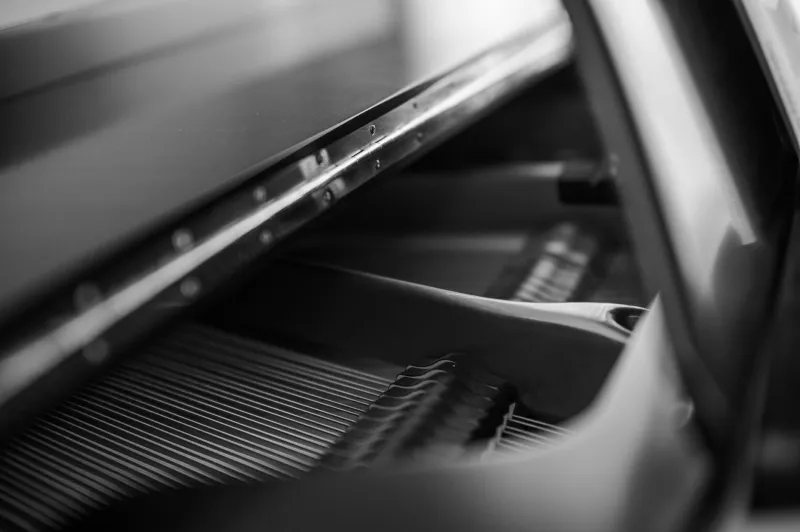
Growing up in Cleveland in the 1970s, the son of a Turkish immigrant father and an African American mother who sang in her church choir, Evren was surrounded by music before his hearing deteriorated. He played piano by feel as much as by sound — pressing his hands flat against the instrument's wooden body to feel the resonance travel up his arms. He learned early that music had a physical dimension that most musicians took for granted and therefore never thought to explore.
When his hearing declined through his teenage years, he didn't stop playing. He started listening differently.
The Body as Instrument
Deafness is not silence. That distinction is one that hearing people rarely appreciate and that Evren has spent considerable energy trying to communicate. Profound deafness means the absence of the specific sensory experience of sound as most people know it. It does not mean the absence of vibration, frequency, or the physical phenomenon that produces what we call music.
Evren began composing in his early twenties using a combination of tactile feedback, visual score analysis, and a technique he developed himself that he called "bone mapping" — a method of pressing different bones of the face, jaw, and skull against resonant surfaces to detect the specific frequencies a given instrument or chord was producing. He could tell a minor third from a major third not by hearing them but by the different vibrations they sent through the structure of his own skeleton.
This sounds exotic. It was, in fact, deeply practical. It forced him to understand harmony as a physical relationship between frequencies rather than as an aesthetic sensation — a shift in perspective that produced compositions of unusual structural clarity.
His early works were performed at small venues in Cleveland and later in Chicago, where he relocated in his late twenties. Critics who reviewed them often noted something they couldn't quite name: a kind of internal logic that made the pieces feel inevitable, as though each note had been placed with a precision that went beyond instinct. What they were responding to, though they didn't know it, was the work of someone who had no choice but to understand music architecturally rather than emotionally.
The Composer Nobody Could Quite Categorize
Evren's work sat uncomfortably between categories. It wasn't classical in any traditional sense. It borrowed from jazz structures and gospel harmonics — his mother's church had left deep grooves in his musical memory — but it didn't belong to either tradition. It was rhythmically complex in ways that suggested both African musical influences and the kind of mathematical precision associated with the European avant-garde.
The music press, which loves a drawer to put things in, mostly gave up and called it "American" — which was accurate but not especially illuminating.
What was more interesting was what happened when hearing musicians sat down to learn his compositions. They almost universally reported the same experience: the pieces were harder to learn by ear than by score. They resisted the shortcuts that most trained musicians use — the pattern recognition, the stylistic intuition, the muscle memory of familiar harmonic progressions. You had to read them carefully, understand their internal logic, and then commit to a kind of deliberate attention that most performers reserve for technically demanding passages rather than for the music's emotional architecture.
In other words, Evren's deafness had produced music that required hearing musicians to listen differently.
The Ripple Effect
Several composers who studied with Evren or encountered his work in the 1990s and 2000s have credited him with changing how they thought about the relationship between structure and sensation in music. The influence is difficult to trace in liner notes — Evren was never famous in the way that generates easy citation — but it shows up in the work of musicians across genres who describe a shift in how they approach composition after encountering his ideas.
One jazz pianist, interviewed for a documentary on the Chicago music scene, put it simply: "He made me realize I'd been using my ears as a crutch. Not a bad crutch — ears are pretty useful. But a crutch. There was a whole other way to think about what I was making, and I'd never had to find it because I could just listen."
That reframing — deafness as a discipline rather than a deficit — is the heart of Evren's story and the thing that makes it matter beyond the inspirational surface.
Sound as Architecture
Evren now teaches at a small conservatory outside of Chicago. He works with both hearing and deaf students, and he makes no particular distinction in how he approaches either group. He teaches music as a physical and mathematical phenomenon first, an auditory experience second — an approach that has produced students who describe a relationship to composition that is more conscious and less reflexive than what most music education produces.
He communicates in a mixture of American Sign Language and speech, and he still presses his hands against pianos when students play for him. He's not listening, exactly. He's reading.
"Sound is information," he said in a 2019 interview conducted partly in ASL. "Most people receive it passively. I had to learn to receive it actively. That turned out to be the education."
The music world he helped shape didn't always know his name while it was being shaped. That's fine with him. The work is what mattered. The work, and the quiet revelation that what looks like a wall is sometimes, if you're paying close enough attention, a door.
You just have to learn to feel where the handle is.