Numbers Don't Lie: The Street Hustler Who Became America's Secret Weapon Against Nazi Codes
The Mathematics of Survival
Every morning at sunrise, Marcus "Numbers" Johnson would step out onto 125th Street with a head full of calculations and pockets full of slips. The year was 1935, and while Wall Street brokers were still licking their wounds from the crash, the underground economy of Harlem was thriving on a different kind of mathematics altogether.
The numbers racket wasn't just gambling—it was a complex system that required lightning-fast mental arithmetic, pattern recognition, and an intuitive understanding of probability that would make a statistician weep. Johnson, barely twenty and fresh off a sharecropping farm in Alabama, had found his calling in the chaotic ballet of street-corner bookmaking.
"You had to keep track of hundreds of bets in your head," recalled his neighbor, Mrs. Dorothy Williams, in a 1987 interview. "Marcus could tell you who bet what number three weeks ago and whether they were due for a win. The man's mind was like a machine."
What Johnson didn't know was that he was developing skills that would later prove invaluable to the U.S. military. The same pattern recognition that helped him track betting trends and spot potential police raids would eventually help crack some of the most sophisticated enemy communications of World War II.
When Uncle Sam Came Calling
By 1942, the war was raging on multiple fronts, and America desperately needed codebreakers. The military had already recruited mathematicians from universities, but they were still struggling with certain types of enemy transmissions—particularly those that seemed to follow no logical pattern.
Johnson's path to military service was anything but conventional. After a police raid shut down his numbers operation, he faced a choice: jail time or military service. He chose the latter, expecting to spend the war peeling potatoes or digging trenches.
Instead, his intake interview revealed something remarkable. When given a series of seemingly random number sequences as part of a routine aptitude test, Johnson spotted patterns that had escaped notice from college-educated recruits. Within weeks, he found himself on a train to a classified facility outside Washington, D.C.
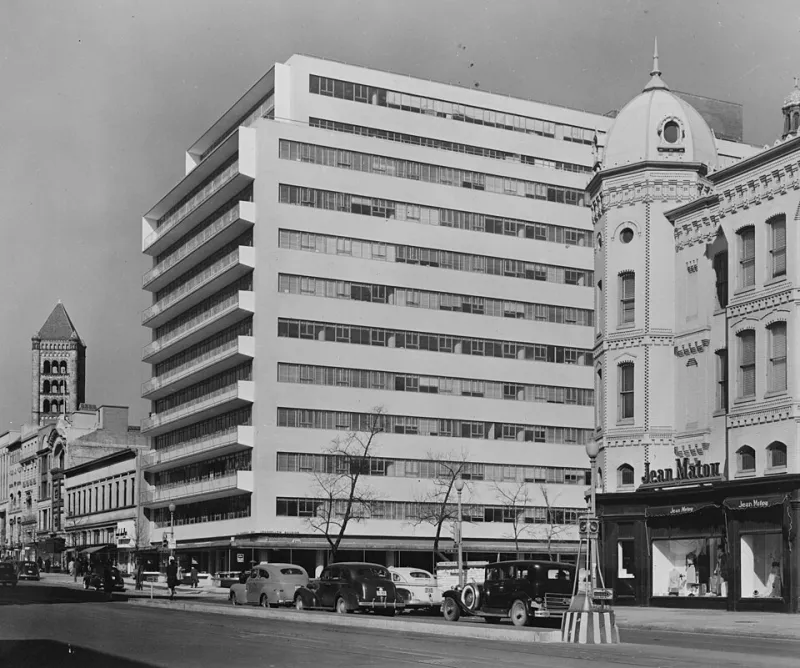
 Photo: Washington, D.C., via jooinn.com
"They put me in a room with a bunch of professors and told me to look at these coded messages," Johnson later told his grandson. "I kept seeing the same thing I saw on the street—people think they're being random, but they're not. Everyone's got a system, even when they don't know it."
The Code Inside the Code
The breakthrough came during the winter of 1943. Allied forces had intercepted a series of German communications that appeared to be completely random—no repeating patterns, no mathematical relationships that traditional cryptographic methods could exploit.
While trained cryptographers focused on frequency analysis and standard decryption techniques, Johnson approached the problem differently. He treated the coded messages like betting patterns, looking for the human element hidden within the apparent randomness.
"Numbers don't lie, but people do," he would often say. "And when people try to be random, they always mess it up somehow."
Johnson noticed that certain number combinations appeared slightly more frequently than pure randomness would suggest—a pattern so subtle that conventional analysis had missed it entirely. It turned out that German operators, trying to create "random" encryption keys, were unconsciously influenced by dates, addresses, and other meaningful numbers from their personal lives.
This insight led to a breakthrough that helped Allied forces anticipate several major German troop movements in the final year of the war. Johnson's street-smart approach to pattern recognition had uncovered a vulnerability that academic training had missed.
Beyond the War
After the war, Johnson faced the same challenge as many African American veterans: a country that had needed his skills in wartime but wasn't ready to recognize his contributions in peacetime. Despite his proven abilities, opportunities in the emerging field of computer science and cryptography remained largely closed to him.
Undeterred, he returned to Harlem and opened a small accounting firm, using his mathematical gifts to help local businesses navigate tax codes and financial planning. His client base grew through word of mouth—people knew that Marcus Johnson could make sense of numbers that confused everyone else.
"He never talked about the war much," remembered his daughter, Patricia Johnson-Williams. "But sometimes when I was struggling with math homework, he'd sit down and show me how to see patterns in problems. He'd say, 'The answer's always there—you just have to know how to look.'"
The Pattern Continues
Johnson's story remained largely unknown until the 1990s, when declassified military documents began revealing the contributions of unconventional wartime codebreakers. By then, he had passed away, but his legacy lived on in the dozens of young people he had mentored in mathematical thinking.
Today, as artificial intelligence and machine learning reshape how we think about pattern recognition, Johnson's intuitive approach seems remarkably prescient. The same skills that helped him survive on Harlem's streets—the ability to spot subtle patterns, think probabilistically, and stay one step ahead of complex systems—are now recognized as fundamental to modern data science.
His story reminds us that genius often emerges from the most unexpected places. Sometimes the training ground for extraordinary achievement isn't a classroom or laboratory, but the unforgiving mathematics of survival itself. In Marcus Johnson's case, the numbers he learned to run on the streets of Harlem eventually helped run the Nazis out of business.