Mop to Motherboard: The Custodian Who Talked His Way Into the Room Where the Future Was Built
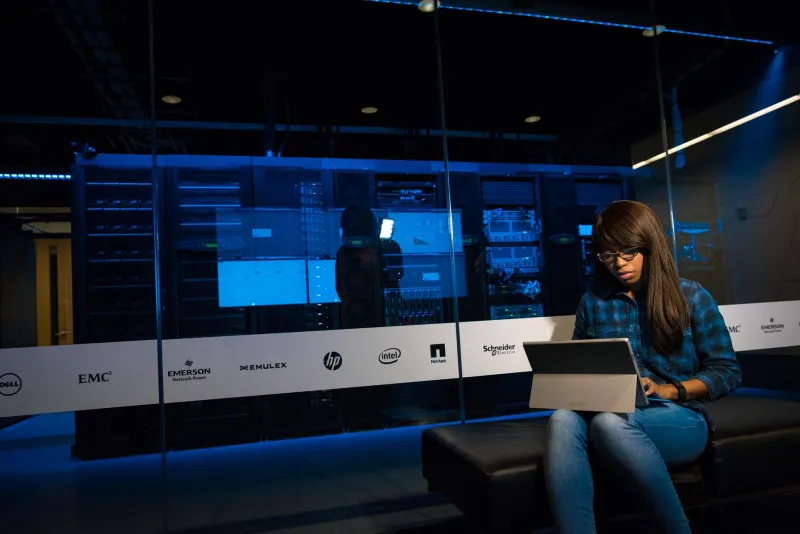
The badge said "Facilities." The ambition said something else entirely.
When Marco Delgado-Reyes arrived in the San Jose area in the early 2000s, he carried two things: a tenth-grade education from a school in Fresno that had run out of money before it ran out of students, and a curiosity so relentless it bordered on compulsive. He'd taught himself basic electronics by salvaging broken radios from a neighbor's trash. He'd read every library book on circuitry that his branch stocked — all four of them. He wasn't looking for a career in technology when he applied for a custodial position at a mid-sized networking firm. He was looking for rent money.
What he found instead was the most expensive classroom in the world, left unlocked every night after 6 p.m.
The Invisible Man in the Server Room
There's a particular kind of invisibility that comes with a maintenance uniform. Engineers who would have clammed up around a competitor would talk freely in front of Marco, the way people speak openly around a piece of furniture. He heard conversations about routing protocols and firmware bugs. He watched developers debug code at whiteboards they forgot to erase before heading home. He learned the vocabulary of a field he'd never formally studied by absorbing it the way a sponge absorbs water — slowly, completely, without anyone noticing.
He started asking questions on his breaks. Small ones at first. What does that do? Then bigger ones. Why does it fail that way? The engineers who answered him didn't think much of it. Some were dismissive. A few were generous. One — a senior network architect named Patricia Huang — handed him a dog-eared copy of a TCP/IP textbook and told him to bring it back when he'd finished it.
He brought it back in eleven days with notes in the margins.
Learning at the Speed of a Mop
What Marco lacked in formal education he compensated for in access and time. His shift ended at midnight. The company's server room — a humming, blinking cathedral of hardware — was never completely empty, but it was close enough. He'd been given keys for cleaning purposes. He used them for something else entirely.
He wasn't breaking rules, exactly. He was bending the spirit of them so gently that no one thought to complain. He'd finish his rounds early, then sit in the break room adjacent to the server room with a borrowed laptop, working through online tutorials that were still a novelty in the early broadband era. He found forums where engineers argued about problems. He started lurking. Then he started answering.
His username — mopper77 — became known in a couple of niche networking communities for giving surprisingly precise, practical answers to real-world infrastructure questions. Nobody knew what he did for a living. Nobody asked.
The Night the Network Went Down
The turning point came during a product launch that went sideways at 11:30 p.m. on a Thursday. The company's internal network collapsed under load. The on-call engineer was stuck on the freeway. The backup engineer wasn't picking up. The CTO was in the building, watching the launch metrics die on his laptop, when Marco knocked on the open door of the server room.
"I think I know what it is," Marco said.
The CTO looked at the badge. He looked at the mop leaning against the wall. He looked back at his dying laptop screen.
"Go ahead," he said.
It took Marco forty minutes to isolate a misconfigured switch that had been throttling bandwidth across the entire office. He walked the CTO through every step he took and why. The network came back up at 12:14 a.m. The launch was salvaged. The CTO sat quietly for a moment, then asked Marco how long he'd been working in IT.
"I work in facilities," Marco said.
The Offer Nobody Expected
The company didn't immediately hand Marco an engineering title. The HR process took months and involved a series of informal technical evaluations that Marco later described as "the strangest job interviews I've ever heard of, and I've heard of some strange ones." There were people inside the company who pushed back — credentialism being the tech industry's most persistent and least examined religion. The argument that a person without a degree couldn't be trusted with infrastructure that Fortune 500 clients depended on was made, sincerely and repeatedly, by people who should have known better.
Patricia Huang, the architect who'd lent him the textbook, made a different argument. She pointed to the forum posts. She pointed to the Thursday night rescue. She pointed out that the skills required to do the job were demonstrably present and that the paper confirming them was not.
Marco was hired as a junior network technician. Within three years, he was a senior engineer. Within five, he was running a team.
What the Badge Never Said
Marco's story isn't a fairy tale about a company that suddenly became meritocratic. The barriers were real, the skeptics were loud, and the path was crooked in ways that would have stopped most people cold. What made the difference wasn't luck — or not only luck. It was the specific alchemy of access and obsession that the tech industry accidentally provides to the people it hires to clean up after itself.
The server rooms are full of knowledge. The break rooms are full of conversations. The whiteboards get erased in the morning, but not always the night before. For someone paying close enough attention, a custodial position at a technology company is less a dead end than a strange kind of scholarship — one that nobody officially offers and nobody officially acknowledges.
Marco has talked about this in the years since, in interviews and at community college panels he volunteers for in the San Jose area. He's consistent on one point: the technology wasn't the hard part. The hard part was convincing people that he'd learned it.
"The room was never locked," he says. "The door in people's heads — that was the one I had to break down."
He broke it down. And then he walked through.