When Sight Became Vision: The Boy Who Lost His Eyes and Found His Voice in America's Senate
The Day the World Went Dark
The first accident happened when Thomas Pryor Gore was nine years old. A stick thrown by a playmate struck his right eye, leaving him partially blind. Most boys would have learned to be more careful. Thomas Gore learned something else entirely — that the world was about to test just how badly he wanted to stay in it.
Two years later, in 1882, a second accident claimed the sight in his remaining eye. At eleven, the boy from rural Mississippi faced a future that, by every measure of his time, looked impossibly narrow. Blind children didn't become lawyers. They certainly didn't become senators. They became burdens, charity cases, forgotten footnotes in other people's stories.
Thomas Gore had different plans.
Memory as a Superpower
What happened next reads like something from a different century — which, in many ways, it was. Without sight, Gore developed what can only be described as a photographic memory for sound. He trained himself to absorb entire speeches, legal documents, and political treatises through hearing alone. While his sighted peers took notes, Gore built libraries in his mind.
By his teens, he was already outpacing law students twice his age. He didn't just memorize cases; he internalized the rhythm of legal argument, the cadence of persuasion, the subtle art of verbal chess that would define his career. When others saw a disabled boy, Gore was quietly becoming something far more dangerous: a master of the spoken word in an era when oratory was political power.
His law practice in Texas proved that blindness, rather than limiting his abilities, had sharpened them to a razor's edge. Juries didn't just listen to Thomas Gore — they hung on every word. Here was a man who couldn't see their faces but seemed to read their souls.
The Territory That Needed a Voice
In 1901, Gore made a move that would define both his career and American history. He relocated to Lawton, in what was then Indian Territory — the wild, unorganized land that would soon become Oklahoma. It was a place where traditional rules didn't apply, where a man could reinvent himself completely.
And Gore did exactly that.
As Oklahoma Territory and Indian Territory prepared for statehood, Gore positioned himself at the center of the political whirlwind. He understood something that his sighted competitors missed: this wasn't just about creating another state. This was about writing the rules for an entirely new kind of American community, one where oil wealth and agricultural tradition would collide to create unprecedented opportunity.
When Oklahoma achieved statehood in 1907, the legislature faced a historic choice for its first U.S. Senate seats. They could play it safe with conventional candidates, or they could send a message about what this new state represented.
They chose Thomas Gore.
Breaking Every Rule in Washington
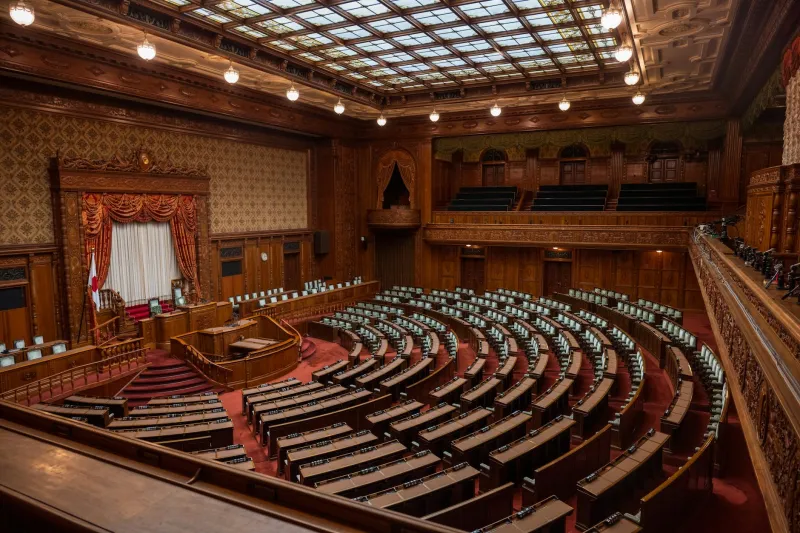
Walking into the U.S. Senate in 1907, Gore became the first blind person ever elected to that body. But he wasn't there to be a symbol or a curiosity. He was there to work, and work he did.
Gore's Senate career reads like a master class in political effectiveness. Unable to read documents himself, he assembled a network of aides and allies who became his eyes and ears. But the real genius was his speaking ability. In an era before microphones and television, when senators had to project their voices to packed galleries, Gore's trained oratory gave him a massive advantage.
His colleagues quickly learned that debating Thomas Gore required serious preparation. He could quote precedent from memory, cite statistics without notes, and deliver rebuttals that seemed to anticipate his opponents' arguments before they made them. What looked like a disability had become a political superpower.
The Dynasty He Built
Gore served three separate terms in the Senate, spanning from 1907 to 1921 and again from 1931 to 1937. But his real legacy wasn't just his own career — it was the political and intellectual dynasty he helped create.
His daughter Nina married Eugene Vidal, and their son would become one of America's most celebrated writers. Gore Vidal took his grandfather's first name as his own last name, carrying forward the memory of the blind senator who had shown that limitations were just starting points for extraordinary achievement.
The Vision Thing
Thomas Gore's story isn't just about overcoming disability — it's about redefining what disability means in the first place. In an era when blindness was seen as disqualifying, Gore proved that different abilities could create different kinds of excellence.
He couldn't see the faces of his constituents, but he heard their voices with unusual clarity. He couldn't read the morning newspapers, but he understood the deeper currents of American politics with remarkable precision. He couldn't navigate by sight, but he found his way to influence that outlasted most of his sighted colleagues.
When Thomas Gore died in 1949, he had lived to see his grandson become a literary sensation and his political legacy help shape modern Oklahoma. The boy who lost his sight at eleven had spent eight decades proving that vision and sight were two entirely different things.
Sometimes the clearest view comes from learning to see in the dark.