The Man Who Swept the Halls and Saw Everything: How One School Custodian's Ground-Level View Changed the Way America Teaches Its Forgotten Kids
There is a particular kind of invisibility that comes with certain jobs. Not the invisibility of being ignored — though that's part of it — but the invisibility of being beneath notice. Of moving through rooms full of decision-makers and never being asked what you think. Of watching, year after year, while the people with titles and offices make choices about a world you understand better than they do.
For Al Johnson, that invisibility lasted nearly two decades. Then it became the most powerful credential he had.
The Hallways as Classroom
Al Johnson took a job as a custodian at Jefferson High School in a mid-sized Midwestern city in the early 1980s, when he was twenty-four and needed steady work. He had grown up poor, had dropped out of college after one semester when the money ran out, and had spent a few years drifting between construction sites and warehouse floors before landing the school job.
He expected to stay a year or two.
He stayed eighteen.
What kept him wasn't the pay, which was modest, or the work itself, which was physically demanding and relentlessly unglamorous. What kept him was the school — specifically, what he could see happening inside it that nobody else seemed to be watching.
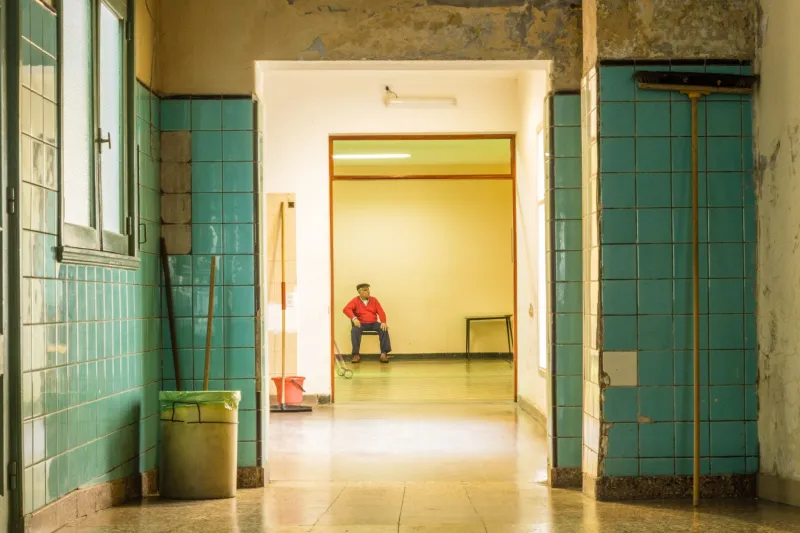
As a custodian, Johnson moved through the building at hours and in spaces that teachers, administrators, and counselors rarely visited. He was in the hallways before the first bell and after the last one. He cleaned the bathrooms where kids cried between classes. He emptied the trash cans outside the principal's office during disciplinary meetings and could hear the conversations through the hollow door. He restocked supply rooms and watched which classrooms ran out of paper by October and which ones had shelves full of materials no teacher had touched.
He saw the school the way you see a city from a maintenance tunnel — all the infrastructure that makes the surface work, and all the places where it was quietly failing.
Notes on the Margins
Somewhere around year five, Johnson started writing things down.
Not formally — not at first. Just observations in a spiral notebook he kept in his locker. Which kids ate breakfast alone every morning. Which teachers closed their classroom doors during free periods and which ones left them open for students who had nowhere else to go. Which hallways the most isolated kids avoided, and why. The rhythms of the building's social geography, invisible to anyone who only moved through it during official hours.
Over time, the notebooks filled up. Johnson started reading — voraciously, self-directedly — in the evenings. He found Paulo Freire's Pedagogy of the Oppressed at a used bookstore and recognized something in its description of education as a system that could either liberate or contain. He read Jonathan Kozol's Savage Inequalities, which had been published in 1991 and described the resource gaps between wealthy and poor school districts in terms that matched, almost exactly, what he had been documenting in his notebooks for years.
He wasn't an academic. He had no graduate degree, no institutional affiliation, no professional network. What he had was eighteen years of sustained, close-range observation of one school's machinery — and a growing conviction that the people designing reforms had never actually spent time inside the building they were trying to fix.
The Memo That Reached the Wrong Desk — and Then the Right One
In 1999, a new principal arrived at Jefferson High: a young administrator named Dr. Patricia Welles, who had come in with a mandate to improve test scores and reduce the school's dropout rate, which had climbed steadily through the 1990s.
In her first month, she organized a series of staff listening sessions. She invited teachers, counselors, and department heads. She did not invite the custodial staff.
Johnson showed up anyway — not to the meeting, but to Dr. Welles's office the following morning, with a twelve-page typed memo summarizing his observations and a request for fifteen minutes of her time.
Welles, by her own later account, almost didn't read it. The memo had been left with her assistant, who had placed it at the bottom of a stack of teacher feedback forms. She got to it three days later, expecting a complaint about cleaning supply budgets.
She read it twice. Then she called Johnson in.
What followed was a series of conversations that Welles has described as the most disorienting and clarifying professional experience of her career. Johnson walked her through the building the way a naturalist walks someone through an ecosystem — pointing out patterns, relationships, and pressure points she had never had reason to notice. The corner near the gym where the kids most likely to drop out congregated every morning, not out of defiance but because it was the only place in the building where a particular security guard didn't hover. The supply room whose contents told a story of systematic underinvestment in the school's lowest-performing classrooms. The bathroom on the third floor where, for reasons no administrator had investigated, three different students had been found crying in the same semester.
Building Something From the Bottom Up
With Welles's support, Johnson began formalizing his observations into a framework he called proximity-based assessment — a methodology for understanding school culture by mapping the informal social geography of a building rather than relying solely on test scores and attendance data.
The approach was simple in concept and radical in practice: before designing any intervention, spend time in the spaces students actually occupy, during the hours they actually occupy them, watching what they actually do. Talk to the people who are always present — custodians, cafeteria workers, bus drivers — before designing programs that assume you understand the environment.
Johnson enrolled in a night program at a regional state university, earned his bachelor's degree at forty-one, and completed a master's in education policy at forty-five. His thesis drew directly on his eighteen years of custodial observation and was cited in three academic papers within a year of publication.
By 2008, he had been invited to present his framework at a national conference on urban education reform. By 2012, a version of his proximity-assessment model had been piloted in school districts in Ohio, Georgia, and New Mexico. A 2015 study published in the Journal of Education for Students Placed at Risk found that schools using the model showed measurable improvements in early dropout identification and intervention.
What the Mop Taught the Reformers
Al Johnson didn't revolutionize American education by storming the gates of academia or disrupting a system from the outside. He did it by being so thoroughly inside the system — so embedded in its daily, unglamorous operation — that he could see it with a clarity that no consultant, researcher, or administrator ever had.
The insight that powered his work was almost embarrassingly straightforward: the people closest to a problem understand it best. Not in spite of their low status, but partly because of it. The custodian sees the school that nobody performs for. The cafeteria worker hears the conversations nobody edits. The bus driver knows which kids are exhausted before they ever reach a classroom.
Johnson spent years being invisible. Then he wrote down everything he'd seen.
It turned out to be more than enough.