The Refugee Who Rebuilt America's Skyline: How an Architect with Nothing Designed Everything
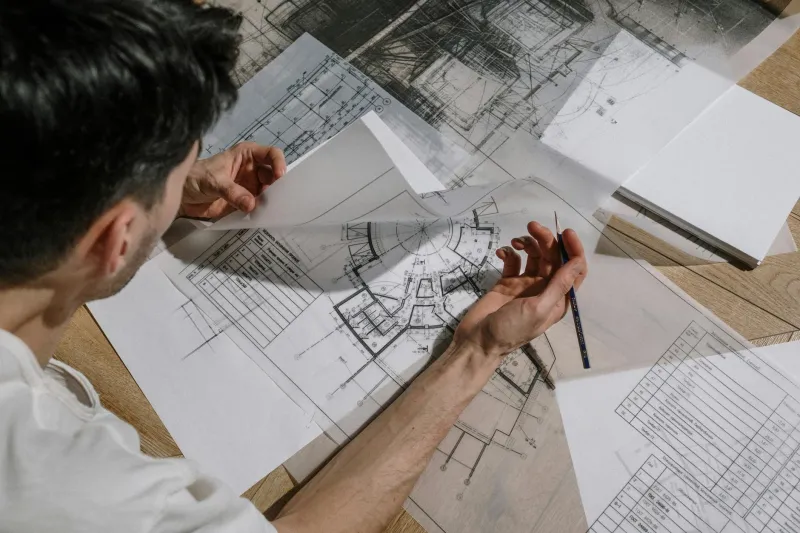
The Man Who Carried Cities in His Coat
Hassan Fathy stepped off the cargo ship in Baltimore harbor in 1952 with $23 in his pocket, three changes of clothes, and architectural blueprints carefully sewn into the lining of his winter coat. The immigration officer barely glanced at his credentials—a degree from Cairo's prestigious Faculty of Fine Arts meant nothing here. What mattered was that Fathy spoke broken English, had no American references, and looked exactly like what he was: another refugee hoping America might have room for his dreams.
The construction foremen who turned him away that first brutal winter couldn't have known they were rejecting the man who would eventually design the buildings where their grandchildren would work, live, and dream.
Building from Nothing
Fathy's first job wasn't designing skyscrapers—it was sweeping the floors where other architects worked. At night, in a shared tenement room in Brooklyn, he studied American building codes by candlelight and sketched his ideas on the backs of grocery bags. His roommates, also refugees from various wars, thought he was crazy for carrying those rolled-up papers everywhere.
"He never let go of those drawings," remembered Dimitri Petrov, a displaced engineer from Eastern Europe who shared that cramped apartment. "Even when we had no food, Hassan wouldn't sell his drafting tools."
What Fathy understood—and what established American architects couldn't see—was that displacement had given him something invaluable: freedom from convention. He wasn't bound by the way things had always been done. He hadn't spent decades learning the "right" way to design American buildings. Instead, he saw American cities with the fresh eyes of an outsider who had lost everything except his vision.
The Breakthrough Nobody Saw Coming
Fathy's moment came in 1958, six years after arriving in America. A small development company in Queens needed someone to design affordable housing that didn't look like the soul-crushing projects going up everywhere else. They couldn't afford the big firms, so they took a chance on the quiet refugee who'd been sweeping their floors and occasionally offering suggestions.
What Fathy delivered stunned everyone. His design merged Middle Eastern courtyard concepts with American efficiency, creating buildings that were both functional and beautiful. More importantly, they were affordable to build but didn't feel cheap to live in. He had solved a problem that had stumped American architects for decades: how to create dignity in low-cost housing.
"Hassan didn't just design buildings," said Maria Santos, one of the first residents of his Queens project. "He designed a way of living that made you feel human again."
The Philosophy Born from Loss
What made Fathy's work revolutionary wasn't just his aesthetic—it was his understanding of displacement. Having lost his own home, he designed buildings that created instant communities. His layouts encouraged neighbors to meet naturally. His materials were chosen not just for durability, but for how they aged, how they felt to touch, how they made people want to stay.
American architects had been trained to think about buildings as isolated objects. Fathy thought about buildings as extensions of human relationships. This wasn't theory he'd learned in school—it was wisdom earned through the experience of starting over with nothing.
"Every building should be a homecoming," he wrote in his journal, now housed at the Smithsonian. "Not just for the people who live there, but for the neighborhood that receives it."
From Outcast to Oracle
By the 1960s, Fathy's phone wouldn't stop ringing. Cities from coast to coast wanted the refugee architect who somehow understood American urban life better than architects born here. His firm grew from his kitchen table to three floors of a Manhattan high-rise—a building he had also designed.
His masterpiece came in 1971: the Riverside Cultural Center in Chicago. The project had defeated three major firms before landing on Fathy's desk. He created a building that seemed to grow from the lakefront itself, incorporating Islamic geometric patterns with Prairie School influences in a way that shouldn't have worked but absolutely did.
"Hassan didn't just blend styles," said architecture critic Janet Morrison. "He created a new language for what American buildings could be when they embraced everyone who calls this country home."
The Skyline Speaks His Language
Today, you can't drive through an American city without seeing Fathy's influence. The mixed-use developments that make neighborhoods livable? His idea. The public spaces that actually invite the public? His innovation. The affordable housing that doesn't scream its affordability? His revolution.
More than 200 buildings across the United States bear his direct design. Thousands more were influenced by his principles. Architecture schools now teach "Fathy's Integration Method" as standard curriculum. Yet most Americans have never heard his name.
The Blueprint for Belonging
Fathy died in 1989, an American citizen whose adopted country had been transformed by his vision. At his funeral, speakers represented every major architectural firm in the country—the same firms that had once refused to interview him.
But perhaps his real legacy lives in the daily experiences of ordinary Americans who feel more at home in their cities because a refugee understood something about belonging that the native-born had forgotten. Sometimes the people who rebuild our world are the ones who know most intimately what it means to lose everything.
In his final interview, Fathy reflected on his journey from displaced person to American icon: "I came here with nothing, so I had nothing to lose by imagining everything differently. Sometimes that's exactly what a place needs—someone who can see it with completely fresh eyes."
Those fresh eyes reshaped America's skyline, one building at a time, proving that the most transformative visions often come from the most unlikely places.