Patterns of Resistance: How Enslaved Women Wove Freedom Into Every Stitch
Patterns of Resistance: How Enslaved Women Wove Freedom Into Every Stitch
On the surface, it was just quilting. Women gathering scraps of fabric, stitching patterns that had been passed down for generations—a domestic skill, humble and ordinary. But beneath those patterns lay something far more radical: a secret language written in cloth, a navigation system for the desperate, a conversation about freedom that slaveholders could not read.
This is the story of how some of the most constrained people in American history became some of the most ingenious. Enslaved women didn't have access to maps, printing presses, or formal education. What they had was needle and thread, scraps of fabric, and an unbreakable will to help their people survive.
The Language Nobody Could Read
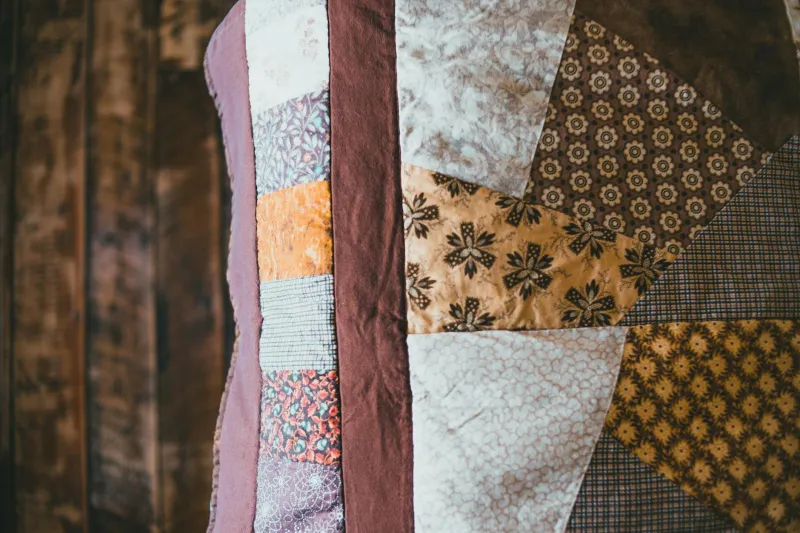
The quilts themselves were masterpieces of hidden communication. A pattern called "Log Cabin" might indicate a safe house—the lighter center representing a light burning in the window. "Bow Tie" patterns could signal that travel was possible. "North Star" designs pointed toward freedom, quite literally. "Drunkard's Path," with its deliberately confusing angles, suggested the winding, unpredictable routes that freedom seekers should take.
But the patterns were only part of the code. The colors mattered too. The placement of stitches carried meaning. The way fabric was folded and displayed in windows communicated messages across distances—telling travelers when it was safe to move, where to go next, who would shelter them.
What made this system brilliant wasn't just the creativity; it was the invisibility. A white person looking at a quilt saw decoration. They saw the expression of a woman's artistic skill, something to admire perhaps, but never to suspect. The quilts hung in cabins and on clotheslines in plain sight, broadcasting directions to freedom while remaining completely opaque to the people who enforced slavery.
Ordinary Women, Extraordinary Courage
Historians have worked to recover the names and stories of these women, though many remain lost to time. We know that quilting circles became planning meetings. We know that women like Harriet Tubman—herself illiterate but brilliant—relied on networks of women who understood these patterns, who knew the safe houses, who recognized the coded quilts.
These women were not formally trained in cryptography or cartography. They were mothers, sisters, daughters—people whose names appeared in no official records, whose contributions were never acknowledged in their lifetimes. They couldn't vote, couldn't own property, couldn't legally protect themselves. Yet they created a system so effective, so durable, that it helped thousands of people escape bondage.
The audacity of it deserves to be understood clearly: enslaved women took the one skill they were allowed to develop—needlework—and weaponized it. They took the domestic sphere, the one place they had any autonomy at all, and transformed it into a liberation network.
A Craft Becomes Revolution
What strikes you when you study these quilts is how normal they appear. That's the whole point. A quilt that looked too unusual would raise suspicion. The genius lay in embedding radical information inside something utterly conventional. The patterns had to be beautiful enough to display, ordinary enough to seem innocent, and specific enough to convey precise directions.
Each region had variations. Quilters adapted patterns based on local geography, local safe houses, the specific routes that made sense in their area. The system was decentralized and adaptive—qualities that made it resilient. If one route was discovered, the network didn't collapse. Women adjusted the patterns, created new codes, kept the network functioning.
They also taught their daughters. The knowledge was embedded in the act of teaching—a girl learning to quilt was also learning to read a map written in fabric. She was inheriting a tradition of resistance that looked, to the untrained eye, like nothing more than learning a craft.
What We Lost by Not Listening
For generations, historians overlooked this system entirely. When quilts were studied, they were studied as art or as domestic history—interesting, but not important. The coded messages were invisible to scholars who weren't looking for them, to researchers who didn't ask the right questions of the women who made them.
It wasn't until late-20th-century historians began interviewing descendants and examining quilts with fresh eyes that the full scope of this hidden language became clear. And even now, scholars debate which patterns definitely carried coded meaning and which might be apocryphal. The very secrecy that made the quilts effective as a liberation tool also makes them difficult to definitively decode today.
But that uncertainty doesn't diminish what these women accomplished. Whether every quilt pattern had a specific meaning or whether the system was more flexible and adaptive than we can now reconstruct, the fundamental truth remains: enslaved women created an underground communication network that helped thousands reach freedom.
The Genius of Constraint
There's a temptation to see this as a heartwarming story of female ingenuity—and it is. But it's also something darker and more important: a testament to what happens when people are denied every conventional path to power and agency. These women didn't have the option of becoming generals or politicians or mapmakers. They stitched quilts because that was what they were permitted to do.
What they proved is that brilliance doesn't require credentials or resources or permission. It requires only desperation, creativity, and a refusal to accept that the boundaries drawn around you are final.
The quilts themselves survive—some in museums, some in private collections, some in the homes of descendants who understand their history. They're beautiful objects. They're also revolutionary artifacts. They're proof that the most extraordinary acts of resistance sometimes look, on the surface, like nothing at all.