The Janitor Who Rewired Silicon Valley: How a High School Dropout Became the Quiet Architect of the Personal Computer
The Janitor Who Rewired Silicon Valley: How a High School Dropout Became the Quiet Architect of the Personal Computer
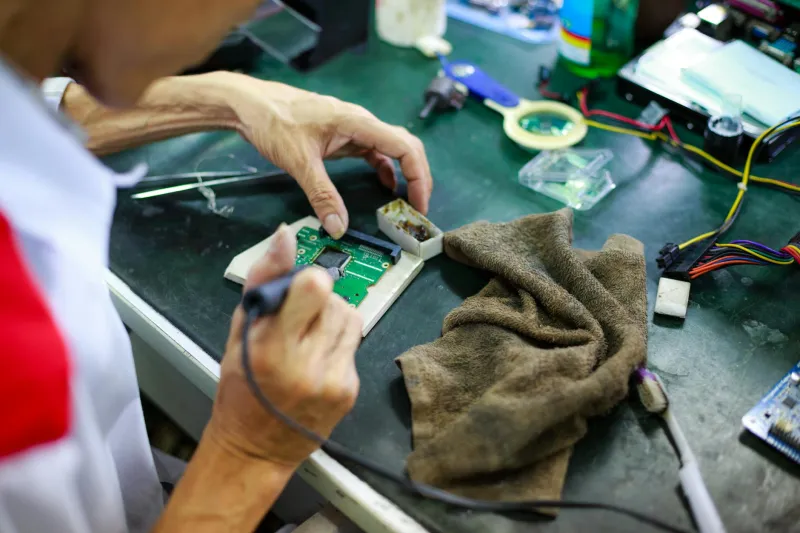
In 1975, while Stanford MBAs were sketching business plans and MIT graduates were filing patents, the real revolution was happening in a cramped garage on the wrong side of San Jose. The man hunched over a workbench, surrounded by salvaged circuit boards and Radio Shack components, didn't have a degree. He didn't have venture capital. What he had was an intuitive understanding of electronics that would quietly reshape computing forever.
Meet Jerry Lawson, the janitor who became the unsung architect of the video game console — and by extension, the personal computer as we know it.
When Dreams Meet Reality on the Night Shift
Lawson's story begins in Queens, New York, where his father worked as a longshoreman and his mother cleaned offices. Electronics wasn't a career path in the Lawson household — it was Jerry's obsession. While other kids played stickball, he was building ham radios from scratch and teaching himself circuit design from library books.
By age 13, he had constructed his own television. Not assembled from a kit — built from components he understood at the molecular level. His neighbors thought he was headed for trouble. His teachers saw a distracted kid who couldn't sit still in class.
They were all wrong.
When the family moved to California in the 1960s, Jerry found himself sweeping floors at Fairchild Semiconductor, the company that would birth Intel and dozens of other tech giants. But while he pushed a mop during the day, he was absorbing everything — every conversation about microprocessors, every discarded schematic, every late-night discussion between engineers who didn't notice the janitor listening in the corner.
The Room He Had No Business Being In
Here's where the story gets interesting. Lawson didn't just clean the labs — he started hanging around after hours, studying the equipment, asking questions that revealed a depth of knowledge that stunned the engineers. Soon, they were inviting him to informal discussions. Then to formal meetings. Then to the drawing board.
Without anyone quite realizing it, the janitor had become a consultant.
Fairchild was working on something revolutionary: the F8 microprocessor, one of the first commercially viable computer chips. But they had a problem. The chip worked beautifully in controlled environments, but real-world applications kept failing in unpredictable ways.
Lawson saw what the PhD engineers missed. The issue wasn't the chip — it was how it interfaced with memory. His solution was elegant and simple: a programmable ROM system that could adapt to different applications without requiring hardware changes.
It was the breakthrough that made modern computing possible.
Building the Future, One Circuit at a Time
But Lawson's biggest contribution came when he left Fairchild to join a tiny startup called Alpex. The company had a wild idea: what if you could play different games on your television without buying a new console every time?
Every major company had tried this and failed. Atari's engineers said it was impossible. Magnavox's team called it a pipe dream. The technology simply didn't exist to make cartridges that could change the entire personality of a gaming system.
Lawson looked at the problem differently. Instead of trying to cram entire games into cartridges, what if the console itself was just a shell — a platform that could become anything the cartridge told it to be? It was a radical inversion of how everyone thought about computing.
Working 16-hour days in a converted warehouse, Lawson and his tiny team built the Channel F, the world's first cartridge-based video game console. More importantly, they created the architectural blueprint that every gaming system — and by extension, every personal computer — would follow.
The concept of modular software running on standardized hardware? That was Jerry Lawson, working in obscurity while the tech world celebrated other names.
The Innovation That Changed Everything
The Channel F wasn't a commercial success — it was too far ahead of its time, too expensive for mass adoption. But its technical innovations rippled through Silicon Valley like wildfire. Suddenly, everyone was building cartridge systems. Everyone was talking about programmable platforms.
Lawson had solved the fundamental problem of personal computing: how to create machines that could be infinitely reconfigured without being rebuilt. His solution — treating software as the variable and hardware as the constant — became the foundation of the entire industry.
Yet when historians write about the birth of personal computing, his name rarely appears. The credit goes to the founders, the venture capitalists, the Stanford graduates who had the connections to turn innovation into industry.
Beyond the Garage: A Legacy in Every Circuit
After the Channel F, Lawson founded his own company, VideoSoft, becoming one of the first Black entrepreneurs in Silicon Valley. He continued innovating, continued solving problems that stumped teams with advanced degrees and unlimited budgets.
But perhaps his greatest achievement was proving that genius doesn't follow the prescribed path. That the most transformative ideas often come from people working in garages, not boardrooms. That a janitor who taught himself electronics could see solutions that escaped rooms full of engineers.
Today, every smartphone, every laptop, every gaming console carries traces of Jerry Lawson's innovations. The modular approach to computing that he pioneered — where software defines capability rather than hardware — is so fundamental we take it for granted.
The Quiet Revolutionary
Lawson passed away in 2011, finally receiving some recognition in his later years as tech historians began uncovering his contributions. But his real legacy isn't in the patents or the products — it's in the proof that innovation belongs to anyone curious enough to ask "what if?" and stubborn enough to find the answer.
In an industry obsessed with pedigree and prestige, Jerry Lawson reminds us that the most important breakthroughs often come from the most unexpected places. Sometimes the person changing the world is the one everyone else overlooks — the janitor in the corner, listening, learning, and quietly rewiring the future.
Silicon Valley likes to tell stories about visionary founders and breakthrough moments. But the real story is messier, more democratic, and infinitely more inspiring. It's about a kid from Queens who never stopped building, never stopped questioning, and never let anyone tell him what he couldn't do.
That's a revolution worth remembering.