The Greatest Heist in Hollywood History Had No Guns — Just Typewriters
The Greatest Heist in Hollywood History Had No Guns — Just Typewriters
Picture this: you've just been released from federal prison. Your name has been dragged through congressional hearings broadcast on national radio. Every major studio in Hollywood has signed a formal agreement never to hire you again. Your passport has been flagged. Your phone might be tapped. Your friends are afraid to be seen with you in public.
What do you do?
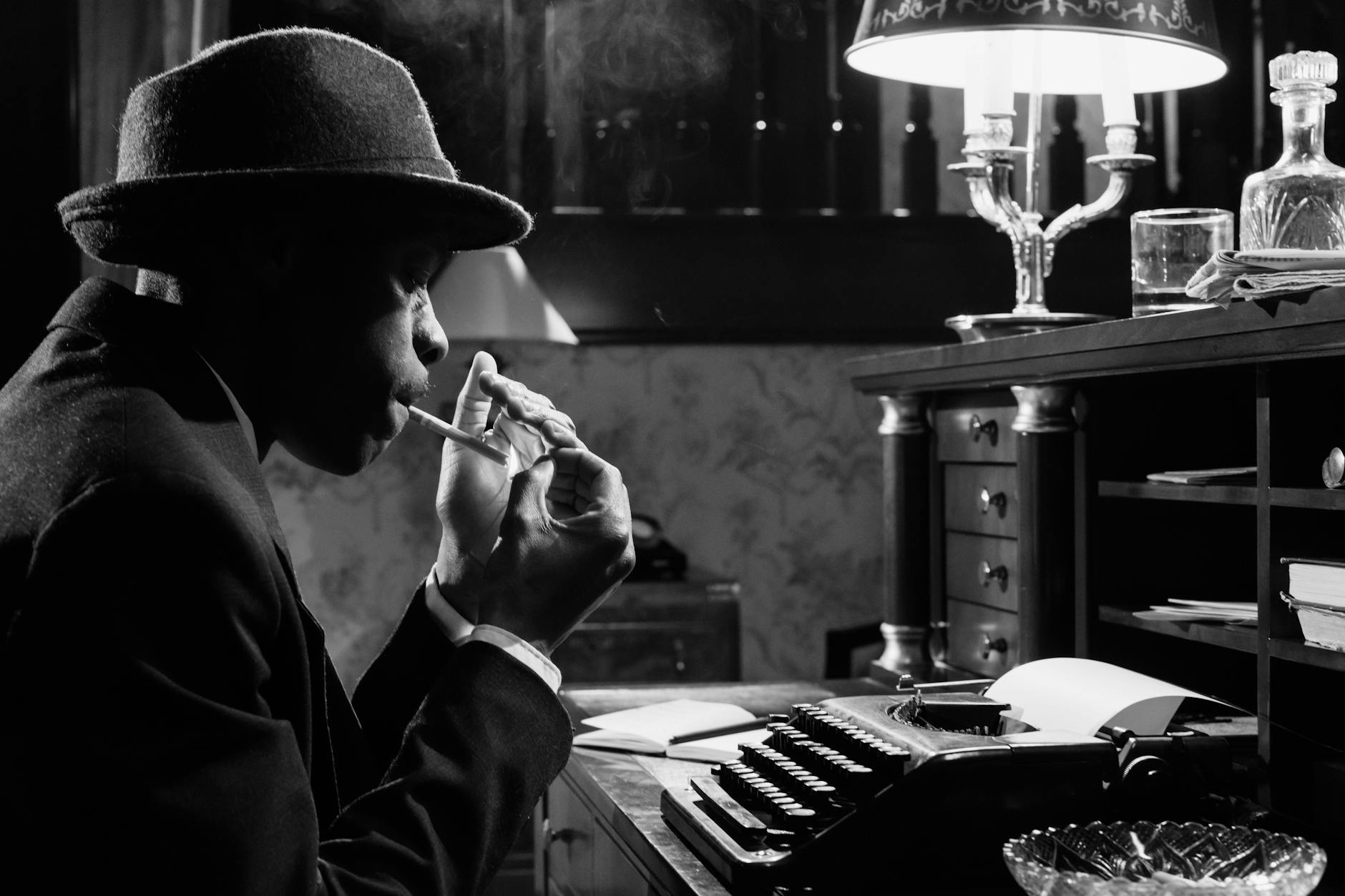
If you were Dalton Trumbo, you lit a cigarette, climbed into a bathtub — his preferred writing spot — and got back to work.
The Setup
By 1947, the Cold War had arrived in America with the subtlety of a sledgehammer, and Washington was hunting Communists the way a fever hunts sleep. The House Un-American Activities Committee — HUAC, an acronym that still carries a chill — turned its attention to Hollywood, convinced that subversive ideas were being smuggled into American living rooms through the movies.
They weren't entirely wrong that Hollywood leaned left. Many of its most gifted writers and directors had flirted with progressive politics during the Depression years, when capitalism had seemed to many like it was actively failing regular people. But political sympathy is a long way from espionage, and HUAC wasn't really interested in the distinction.
When the committee demanded that industry figures name names — identify colleagues with Communist ties — ten of them refused. Screenwriters Dalton Trumbo, John Howard Lawson, Alvah Bessie, Lester Cole, Ring Lardner Jr., Albert Maltz, Samuel Ornitz, and Adrian Scott, along with directors Herbert Biberman and Edward Dmytryk, cited their First Amendment rights and told Congress, essentially, to mind its own business.
They were cited for contempt. They went to prison. And then the studios — in a move that was equal parts cowardice and calculation — formally blacklisted all of them.
The Rules of the Con
The blacklist, at its peak, was one of the most effective acts of institutional suppression in American cultural history. It eventually grew to include hundreds of writers, actors, and directors, some destroyed by mere association or anonymous accusation. Careers evaporated. Marriages collapsed under the pressure. Some people named names to save themselves, a choice that fractured friendships and reputations for decades.
But talent is a stubborn thing. And several of the Hollywood Ten discovered, almost by accident, that the blacklist had a loophole: nobody could stop them from writing. They just couldn't put their real names on it.
The front system was elegant in its simplicity. A blacklisted writer would complete a script, hand it to a willing colleague — someone with a clean name and a flexible conscience — who would submit it as their own. The real author got paid (usually less, sometimes far less). The front got a credit they hadn't earned. The studio got a script it wanted. Everyone kept moving.
Dalton Trumbo was the undisputed master of this underground. He was one of the highest-paid screenwriters in Hollywood before the blacklist, and his output in the shadows was, improbably, even more prolific. He wrote under at least fifteen different pseudonyms. He passed scripts through networks of friends and sympathizers. He turned his bathtub office into a one-man content factory.
In 1953, a film called Roman Holiday won the Academy Award for Best Original Screenplay. The credited writer was Ian McLellan Hunter, a friend who had agreed to front for Trumbo. The actual author was in a bathtub somewhere, probably already working on the next one.
In 1956, The Brave One won Best Original Story. The credited writer was Robert Rich. Nobody at the ceremony had any idea who Robert Rich was, because Robert Rich did not exist. Trumbo had invented him.
When the producers went looking for Rich to collect his Oscar, he was, naturally, nowhere to be found.
The Long Con Pays Out
The blacklist began to crack in the early 1960s, eroded by a combination of legal pressure, public exhaustion, and the sheer practical problem of keeping talented people invisible in a talent-hungry industry. Director Otto Preminger publicly announced that Trumbo had written Exodus under his real name. Kirk Douglas followed suit with Spartacus. The dam broke.
Trumbo was eventually given official credit for Roman Holiday — decades late, posthumously, but officially. Ring Lardner Jr. came back from the blacklist to win a legitimate Oscar for M*A*S*H in 1970, one of the sharpest antiwar comedies ever made, a film that said everything it wanted to say about Vietnam while ostensibly being set in Korea. The system had tried to silence him, and he responded by writing something that outlasted the people who blacklisted him.
Herbert Biberman made Salt of the Earth in 1954, a film about a real New Mexico miners' strike, using blacklisted talent and a non-union crew, under constant harassment from law enforcement and right-wing groups who tried to physically prevent its distribution. It was eventually recognized as one of the most important American films of the 20th century.
What the Heist Actually Stole
The Hollywood Ten's story is often framed as a tragedy, and in some ways it was. Careers were permanently stunted. Some never fully recovered. The damage to individuals — and to the broader culture of creative risk-taking — was real and lasting.
But look at it from another angle, and it reads differently. A group of people had everything institutional stripped away — the credits, the contracts, the industry's protection — and discovered that what remained was the one thing that couldn't be confiscated: the ability to tell a story well.
They adapted. They found new routes. They kept writing, kept working, kept pushing their ideas into the culture through whatever crack in the door was available. They didn't disappear. They went underground and they kept building.
That's not just a Hollywood story. That's the oldest story there is.