In 1903, when Maggie Lena Walker stood before a crowd of Richmond's Black community leaders and announced her plan to open a bank, the room fell silent. Not because the idea was bad — but because it seemed impossible. Here was a woman whose mother had taken in washing to survive, who had been widowed young, who walked with a cane due to a debilitating condition that would eventually confine her to a wheelchair. And she wanted to go head-to-head with the white banking establishment in the heart of the former Confederacy.
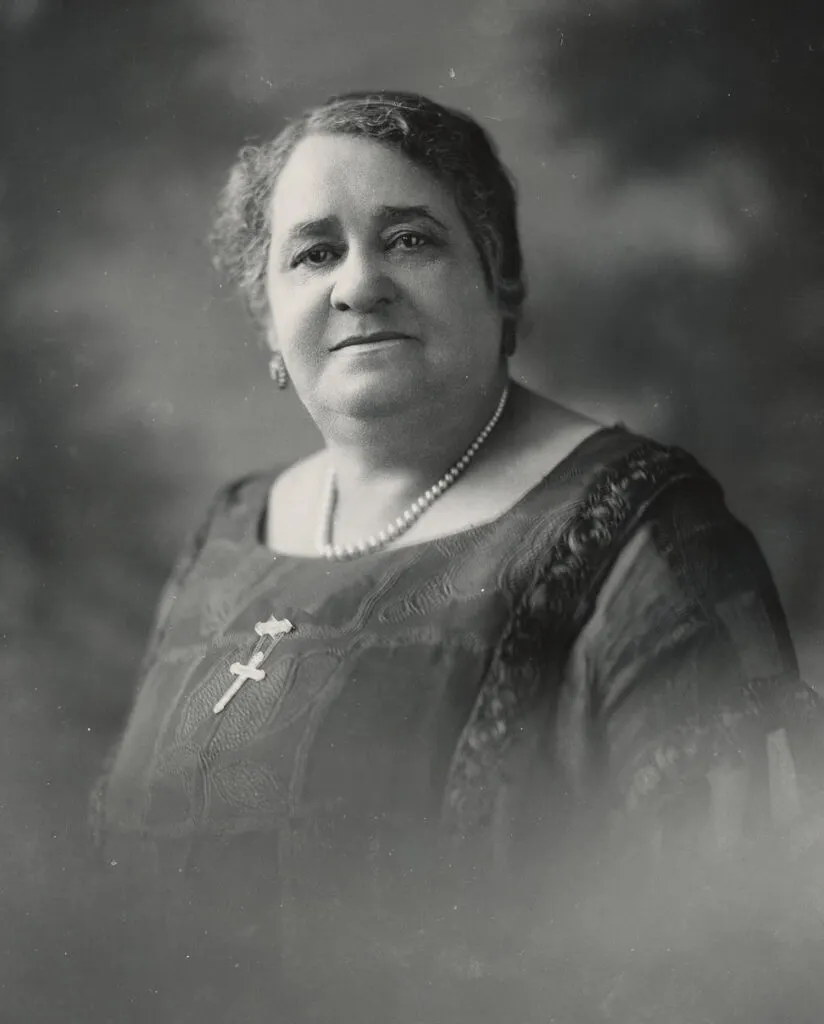 Photo: Maggie Lena Walker, via www.nbhe.net
What happened next would reshape not just Richmond's financial landscape, but the very definition of who could wield economic power in Jim Crow America.
The Washerwoman's Daughter
Maggie Lena Draper entered the world in 1864, born to Elizabeth Draper, a formerly enslaved woman who had found freedom only to discover that survival required backbreaking labor. Elizabeth took in laundry from white families, her hands raw from lye soap and scalding water, her back bent over washboards from dawn to dusk. The small wooden house on Clay Street in Richmond's Jackson Ward wasn't much, but it was theirs.
Young Maggie understood early that education was the only ladder out of poverty her mother could offer. She excelled at the Richmond Colored Normal School, but even as she dreamed of teaching, she knew that marriage and motherhood would likely end any career aspirations. In 1886, she married Armstead Walker Jr., and for a time, it seemed her story would follow the expected script.
Then tragedy struck twice. First, her husband died suddenly in 1915, leaving her to raise two sons alone. Shortly after, a mysterious illness began attacking her mobility, eventually forcing her to rely on crutches and later a wheelchair. By conventional wisdom, these setbacks should have ended any ambitions she harbored. Instead, they became the crucible that forged one of America's most unlikely financial pioneers.
The Power of Pennies
Walker's path to banking began not with grand schemes, but with the humble Independent Order of Saint Luke, a fraternal organization that provided insurance and support to Richmond's Black community. When she joined as a teenager, the organization was struggling with just a thousand members and $31.61 in its treasury.
By 1899, Walker had become the Right Worthy Grand Secretary, and she saw something others missed: those modest membership dues, collected penny by penny from maids, laborers, and small business owners, represented real economic power. The question was how to unlock it.
Walker transformed Saint Luke from a simple mutual aid society into a multimedia empire. She launched the Saint Luke Herald newspaper, which became a voice for Black economic empowerment. She opened a department store that employed dozens of women and kept Black dollars circulating within the community. But her masterstroke was yet to come.
Breaking the Banking Barrier
In November 1903, Walker opened the Saint Luke Penny Savings Bank with $8,000 in capital — much of it scraped together from the organization's members. The name wasn't accidental: she wanted people to know that every penny mattered, that wealth could be built one small deposit at a time.
 Photo: Saint Luke Penny Savings Bank, via www.searchablemuseum.com
The timing couldn't have been more challenging. Jim Crow laws were tightening across the South, designed specifically to prevent Black Americans from accumulating economic power. White-owned banks routinely denied loans to Black customers or charged predatory rates. Walker's bank offered something revolutionary: financial services provided by people who understood their customers' struggles because they shared them.
What made Walker's success even more remarkable was that she was breaking not one glass ceiling, but two. No woman of any race had ever chartered and run a bank in America. The banking world was so thoroughly male-dominated that many questioned whether a woman could handle the "complexities" of finance. Walker's response was characteristically direct: "Let woman's claim be as broad in the concrete as in the abstract."
Building More Than Wealth
The Saint Luke Penny Savings Bank didn't just serve customers; it created them. Walker understood that financial literacy was as important as financial access. She traveled throughout Virginia giving speeches about the importance of saving, homeownership, and business development. Her message was simple but revolutionary: Black Americans didn't have to wait for white approval to build wealth.
Under her leadership, the bank's assets grew from $8,000 to over $400,000 by 1920. More importantly, it enabled hundreds of families to buy homes, start businesses, and send children to college. Walker had created what economists would later call a "community development financial institution" — decades before the term existed.
Her influence extended far beyond banking. She served on the board of the NAACP, fought for women's suffrage, and mentored a generation of Black business leaders. When the Virginia legislature tried to pass a law segregating streetcars, Walker organized a boycott that forced the measure's withdrawal.
The Legacy That Laundered History
By the time Walker died in 1934, she had transformed not just her own circumstances, but the economic landscape of Black America. The bank she founded continued operating until 2009, weathering the Great Depression, the civil rights era, and countless economic storms. For over a century, it stood as proof that financial institutions could serve communities, not just extract from them.
Walker's story challenges every assumption about who gets to wield economic power and how they acquire it. She rose not despite her humble origins and physical challenges, but because they gave her insights that traditional bankers lacked. She understood that true wealth building required serving people whom mainstream finance ignored.
Today, as conversations about financial inclusion and community banking resurface, Walker's model feels remarkably contemporary. She proved that the most transformative financial innovations often come not from Wall Street boardrooms, but from people who understand what it means to count every penny — because they've had to.
In a world that told her she was too poor, too female, too Black, and too disabled to matter, Maggie Lena Walker built something that mattered for generations. Her mother's washboard may have cleaned white folks' clothes, but her daughter's bank cleaned up the economic playing field, one deposit at a time.